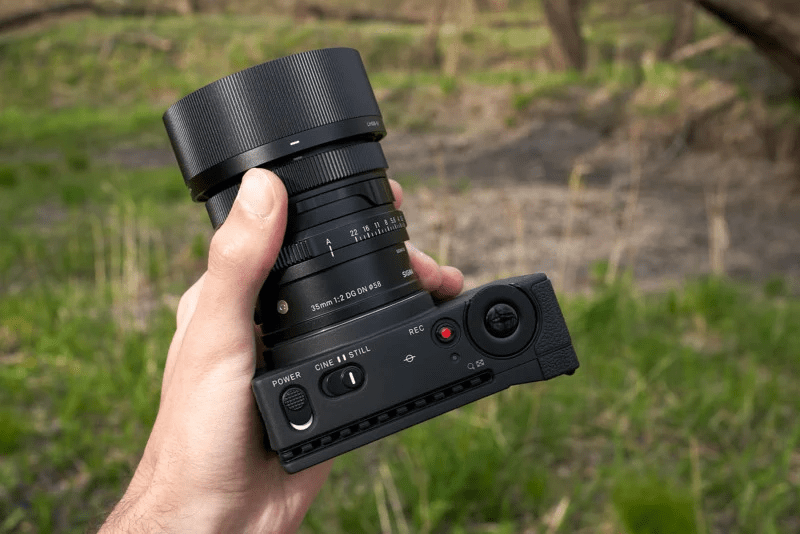
Sigma has just announced the world’s smallest and lightest full-frame mirrorless camera, the Sigma fp. Like best camera for photography other recent Sigma cameras, the fp employs a distinct design. However, unlike previous Sigma cameras, such as the most recent sd Quattro models, the fp does not use their distinct Foveon sensor, but rather utilizes a full-frame 24.6-megapixel Bayer sensor.
Key features and specs
Uses the Leica L-mount
24.6-megapixel full-frame backside-illuminated Bayer image sensor
Electronic shutter only
Native ISO range of 100-25,600
ISO can be expanded down as low as ISO 6 and upward as high as 102,400
49-point contrast-detect autofocus system
Face/eye detect autofocus functionality
Can shoot still images at up to 18 frames per second
Electronic image stabilization for stills and video
Records 12-bit CinemaDNG 4K UHD video at 24p
Records 4K UHD at up to 30p and Full HD at up to 120p in MOV H.264
Supports external SSD recording
Offers videographer-friendly features, including zebra patterns, waveform display and time code
Despite its small stature, the Sigma fp is weather-sealed, including sealing at 42 dedicated points. Further, to ensure good thermal control, the camera not only has a dedicated heat sink between the full-frame image sensor and the touchscreen display, it incorporates die-cast aluminum alloy on the front and back of the camera, a material known for its rigidity and thermal conductivity.
Looking at the camera, you will note that the height of the body is dominated by the lens mount. The lens mount in question is a Leica L-mount, which has recently garnered widespread attention after Panasonic and Sigma joined with Leica to create the L-mount Alliance. It’s a natural shift away from the SA mount for Sigma, given their support of the L-mount, including 14 native L-mount Sigma lenses due to arrive later this year. The Sigma fp can also be used with Sigma’s MC-21 mount converter, which opens up the possibility to use 29 Canon EF and Sigma SA DSLR lenses and 13 Sigma CINE lenses.
On the back of the camera, the body is nearly filled by the 3.15-inch, 2.1-million dot touchscreen LCD. Along the small sliver of space beneath the display, there are playback, view mode, TONE, COLOR and mode buttons. The TONE and COLOR buttons allow direct access to respective tone and color control menus, which we will discuss further in the next section. To the right of the display are AE-L, Quick Select (QS) and Menu buttons, plus a rotating control dial with a central selector button.
The top of the camera has a power switch, a CINE/STILL switch, dedicated recording button and shutter release, which is surrounded by another control dial. Regarding the CINE/STILL switch, the camera offers specially-designed, independent user interfaces for stills and video, including different displays and button assignments.
The Sigma fp has been designed to be versatile and flexible, allowing users, through the use of optional accessories, to drastically change how the camera looks, feels and is used. The flexible design concept includes accessories such as an attachable hot shoe unit to allow for flash use, a Sigma LCD view finder (a bolt-on LCD loupe), a base plate, a small hand grip, a large hand grip, and more.
 Site Title
Leave a comment